Introduction: Dental Patients Do Not Only Call During Office Hours
An AI receptionist for dental offices can help solve a problem that most practices know too well.
The phone rings when the team is busy.
The phone rings during lunch.
The phone rings after hours.
The phone rings on Friday evening.
The phone rings on the weekend.
The phone rings while someone at the front desk is already helping a patient, checking insurance, handling paperwork, calming someone down, and trying not to make direct eye contact with the printer that chose violence again.
That is dental office life.
The problem is not that the team does not care.
The problem is that dental practices are busy, and patients do not only reach out when it is convenient.
A potential patient might call after work because that is when they finally have time.
A parent might call on the weekend because their child has tooth pain.
A nervous patient might call after scrolling through your website for 20 minutes and finally building the courage to ask a question.
A cosmetic patient might call to ask about whitening, veneers, Invisalign, or consultation availability.
If nobody answers, that moment can disappear.
Some people leave voicemails.
Some call back.
But many call the next practice.
That is where an AI receptionist can help.
Not as a replacement for your team.
As a support system.
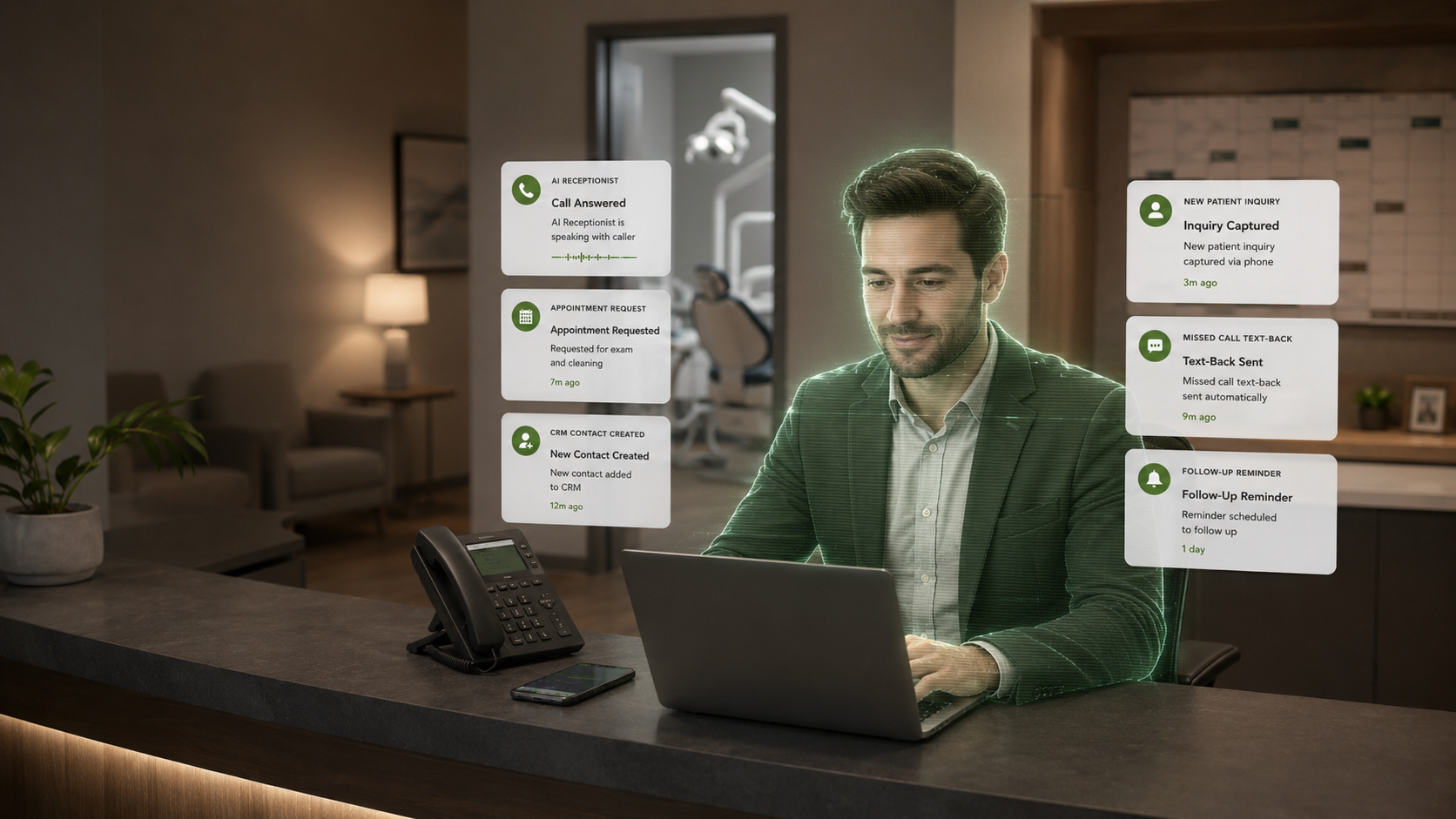
A properly designed AI receptionist can answer calls, collect patient information, answer approved questions, route urgent needs, offer booking options, send follow-up messages, and make sure calls do not vanish just because the office was closed or busy.
For dental offices, this can be a major trust advantage.
Patients want to feel seen, heard, and guided.
Even when the office is not open.
This guide breaks down what an AI receptionist for dental offices does, how it helps with missed calls and appointment requests, what it should and should not handle, where privacy and compliance matter, and how to connect it to your larger dental marketing system.
Because the goal is not to sound futuristic.
The goal is to stop losing patient interest in the gaps.
Quick Answer: What Is an AI Receptionist for Dental Offices?
An AI receptionist for dental offices is a voice or messaging system that can answer incoming calls, collect patient details, answer approved questions, route urgent calls, support appointment booking, and trigger follow-up workflows.
It helps dental practices stay responsive when staff cannot answer live.
Why Dental Offices Miss Valuable Calls
Dental offices are phone-heavy businesses.
New patients call.
Existing patients call.
Parents call.
Insurance questions come in.
Appointment changes happen.
Treatment questions come up.
Emergency concerns happen.
Vendors call too, because apparently they also believe lunch breaks are fictional.
The front desk becomes the center of everything.
That creates a bottleneck.
Even a great front desk team can only handle so much at once.
When calls are missed, the practice may lose appointment opportunities without realizing it.
A missed call might be a patient trying to schedule a cleaning.
It might be a high-value cosmetic consultation.
It might be someone looking for an emergency appointment.
It might be a parent trying to find care quickly.
It might be a returning patient who needs a simple reschedule.
The problem is that a missed call does not announce its value.
It just shows up as a number.
By the time someone calls back, the patient may already have moved on.
That is why dental phone answering should be treated as part of the patient acquisition system.
Not just office admin.
Why Weekend and After-Hours Calls Matter
A lot of people search for healthcare services outside regular office hours.
They may be at work during the day.
They may not have time until evening.
They may sit with a dental concern until it becomes uncomfortable enough to act.
They may use the weekend to compare providers.
That means after-hours calls can carry real intent.
If your office is closed and the only option is voicemail, the patient may not feel confident waiting.
An AI receptionist can help bridge the gap.
It can greet the caller, collect details, explain that the office is closed, answer approved general questions, offer an appointment request option, or send information to the team for follow-up.
It can also help separate routine questions from urgent concerns.
That does not mean the AI should diagnose or give medical advice.
It should not.
But it can ask what the patient needs, capture the request, and guide the next step based on the practice’s approved process.
That is useful.
Because silence is not a patient experience strategy.
Appointment Reminders and Patient Communication Need Care
Dental practices have to be careful with patient communication.
The good news is that appointment reminders are allowed under HIPAA without patient authorization. The U.S. Department of Health and Human Services explains that appointment reminders are considered part of treatment.
The American Dental Association’s guidance on phoning patients also explains that covered dental practices can send certain health care messages to patients if they meet specific requirements.
That said, dental practices should still avoid sloppy communication.
Messages should be clear, limited, and appropriate.
They should not reveal unnecessary sensitive details.
They should respect opt-outs and patient preferences.
If the system uses SMS, the practice should also understand texting and consent rules. Twilio’s U.S. SMS compliance guide is a useful plain-language resource for understanding opt-in, opt-out, and messaging expectations.
The goal is not to automate everything just because the tool can.
The goal is to communicate responsibly.
An AI receptionist should make the patient experience better, not riskier.
What an AI Receptionist Can Handle
An AI receptionist can be useful for common front-end tasks.
It can answer basic questions about office hours, location, services, accepted next steps, and appointment request process.
It can collect caller details.
It can ask if the caller is a new or existing patient.
It can capture the reason for the call.
It can offer a booking link or appointment request flow.
It can notify staff.
It can create a CRM record.
It can send a follow-up message.
It can handle after-hours intake.
It can help reduce voicemail dependence.
This is especially helpful for practices that get repeated questions.
For example, many callers ask whether the office is accepting new patients, what services are offered, how to schedule, where the office is located, whether there is parking, or what happens during a first visit.
Those questions do not always need a live person immediately.
They need a clear, approved answer.
That is where AI can help.
What an AI Receptionist Should Not Handle
An AI receptionist should have boundaries.
This matters a lot in dentistry.
It should not diagnose.
It should not give treatment recommendations.
It should not provide medical, legal, or financial advice.
It should not argue with upset patients.
It should not discuss private patient details unless the practice has designed the system safely and appropriately.
It should not pretend to be a dentist.
It should not overpromise availability, pricing, outcomes, or insurance coverage.
A strong AI receptionist knows when to stop and route.
The best system is not “AI handles everything.”
The best system is “AI handles the front door, then passes the right information to the right person.”
That is how it becomes useful without becoming reckless.
The Patient Experience Should Still Feel Human
A dental AI receptionist should not feel cold.
Patients are often calling with some level of emotion.
They may be nervous.
They may be embarrassed.
They may be in pain.
They may be confused.
They may be trying to make a decision for their child.
The tone matters.
The greeting should be calm.
The questions should be simple.
The system should not talk too much.
The next step should be clear.
A good AI receptionist feels like a helpful intake assistant.
Not like a robot trapped inside a phone tree with unfinished business.
For example, a better after-hours greeting might say:
“Thanks for calling. The office is currently closed, but I can help collect your information so the team can follow up. Are you calling as a new patient, an existing patient, or about an urgent dental concern?”
That is clear.
It does not overpromise.
It guides the caller.
It creates structure.
Why Google Business Profile Is Not Enough
A dental office may receive many calls from Google Search or Maps.
That makes the Google Business Profile important.
Google’s official Business Profile page explains how businesses can appear on Search and Maps, manage reviews, add photos, share updates, and help customers connect.
For dental practices, this profile can influence trust before the patient ever calls.
But the Google profile is not a complete phone system.
Google Business Profile chat and call history are no longer available as of July 31, 2024, according to Google’s Business Profile support update.
That means dental offices should not depend on Google’s old built-in call history tools to manage missed patient inquiries.
The profile can help generate calls.
The office still needs a system to capture, route, and follow up on those calls.
That is where an AI receptionist and CRM system become useful.
How an AI Receptionist Connects to the Dental Office System
The AI receptionist should not sit by itself.
It should connect to the larger patient journey.
A caller reaches out.
The AI answers or captures the missed call.
The system collects the reason for the call.
The caller gets a next step.
The staff receives a summary.
The lead or patient is added to the CRM.
A follow-up task is created.
A booking link or appointment request is sent when appropriate.
A reminder can be triggered later.
That is a system.
Without that connection, the AI is just a voice with nowhere to put the information.
A platform like GoHighLevel can help connect calls, CRM pipelines, calendars, forms, email follow-up, SMS follow-up, missed call text-back, and review request workflows.
For dental offices that want to connect multiple apps, Make can help automate steps between systems, such as creating tasks, updating sheets, routing form data, or triggering internal notifications.
The point is not the tool.
The point is the follow-up path.
AI Receptionist Use Cases for Dental Offices
A dental office can use an AI receptionist in several practical ways.
The most obvious use is missed call capture. If the team cannot answer, the system can respond, collect details, and create a follow-up path.
After-hours intake is another strong use. The system can collect new patient interest, appointment requests, and general questions after the office closes.
Appointment request support can help callers move toward scheduling without waiting for a live callback.
Emergency routing can help collect the nature of the concern and direct the caller according to the practice’s approved protocol.
Review follow-up can be connected after completed visits, if the practice has the right process in place.
New patient intake can collect basic non-diagnostic information before the team follows up.
Each use case should be designed carefully.
Dental offices do not need AI to be clever.
They need it to be useful, safe, and clear.
Common Mistakes to Avoid
The biggest mistake is letting AI say too much.
A dental AI receptionist should not ramble. It should not freestyle medical explanations. It should not answer sensitive questions beyond approved boundaries.
Another mistake is failing to tell the team what happens after the call.
If the AI collects information but nobody reviews it, the system fails.
A third mistake is using automation without clear consent and communication rules.
A fourth mistake is treating AI as a replacement for the front desk instead of support for the front desk.
The front desk still matters.
The team still matters.
The patient relationship still matters.
AI should protect the team’s time, reduce missed opportunities, and improve responsiveness.
It should not make the practice feel less human.
How to Start With an AI Receptionist
Start with the call types your office already receives.
Look at the last 30 days.
When are calls missed?
What questions come up most?
How many calls happen after hours?
How often do patients leave voicemails?
How quickly are calls returned?
Where do new patient calls come from?
This gives you the starting point.
Then write approved answers for common questions.
Keep them short.
Set boundaries for what the AI can answer.
Define escalation rules.
Connect the system to your CRM or follow-up process.
Test the experience.
Call it like a patient would.
Listen for awkward moments.
Fix them before sending real callers through it.
A good AI receptionist should feel clear and helpful from the first interaction.
Tools That Can Support the System
If the practice is building supporting content, landing pages, review graphics, or social posts around patient communication, Envato Elements can help with templates and design assets.
If the practice needs the actual back-end system for calls, booking, CRM, SMS, email, and follow-up, GoHighLevel can help connect the pieces.
If the practice needs custom app-to-app automation, Make can support workflow connections.
But the practice should not start with tools.
It should start with the patient journey.
What happens when someone calls?
What happens when the call is missed?
What happens after hours?
What happens when someone wants to book?
What happens when the team needs to follow up?
Answer those questions first.
Then build the system.
Build a Dental Call System That Does Not Lose Patients
An AI receptionist for dental offices can help capture missed calls, support after-hours intake, guide appointment requests, and reduce pressure on the front desk.
But it has to be designed responsibly.
It should use approved language.
It should respect patient privacy.
It should connect to follow-up.
It should escalate when needed.
It should support the human team, not replace the human relationship.
The DIY route is possible.
You can review HHS appointment reminder guidance, ADA communication guidance, Google Business Profile resources, SMS compliance basics, and tools like GoHighLevel or Make to build a system.
But if you do not want to build the whole thing yourself, CLIK Creatives can create a done-for-you AI receptionist and dental follow-up system around your practice.
That can include AI call handling, missed call text-back, CRM setup, appointment request flows, after-hours intake, staff notifications, patient-safe scripts, SMS and email follow-up, review request workflows, and Google profile connection.
You do not need your front desk to carry the whole communication system alone.
You need a calmer way to capture patient interest, organize follow-up, and make sure calls do not disappear when the office is busy.
If your dental office is missing calls, losing appointment opportunities, or relying too much on voicemail, CLIK Creatives can help turn your phone process into a connected patient capture system.
Quick note: Some links in this article may be affiliate links, which means CLIK Creatives may earn a commission if you buy through them, at no extra cost to you. This keeps things clear for readers and aligned with FTC endorsement guidance.
FAQ
What is an AI receptionist for dental offices?
An AI receptionist for dental offices is a voice or messaging system that can answer calls, collect patient information, route inquiries, support appointment requests, and trigger follow-up workflows.
Can an AI receptionist book dental appointments?
Yes, if it is connected to a calendar or appointment request workflow. The system should follow the practice’s approved scheduling rules.
Is an AI receptionist HIPAA compliant?
The technology alone does not guarantee compliance. Dental practices need proper configuration, patient privacy safeguards, consent handling, vendor review, and approved communication workflows.
Can dental offices send appointment reminders?
Yes. HHS explains that appointment reminders are considered part of treatment under HIPAA and can be made without authorization.
Should an AI receptionist give dental advice?
No. It should not diagnose, recommend treatment, or provide medical advice. It should collect information and route the patient to the team when needed.
Can AI answer dental office calls after hours?
Yes. AI can help with after-hours call capture, basic approved questions, appointment requests, and staff notifications.
What should an AI receptionist ask dental callers?
It can ask whether the caller is a new or existing patient, the reason for the call, contact details, preferred appointment timing, and whether the issue is urgent.
Does Google Business Profile track dental calls?
Google Business Profile chat and call history are no longer available as of July 31, 2024, so practices should use their own phone, CRM, or call tracking system.
What is the biggest benefit of an AI receptionist?
The biggest benefit is capturing patient interest when the team is busy, closed, or unable to answer live.
Can CLIK Creatives build an AI receptionist for a dental office?
Yes. CLIK Creatives can build a done-for-you AI receptionist and follow-up system with call handling, CRM, booking flows, SMS, email, review requests, and patient-safe scripts.
2026 Refresh: AI Receptionists Need Human Handoffs and Clear Boundaries
An AI receptionist can help a dental office respond faster, especially after hours or during front desk overload. But it should not be treated as a replacement for clinical judgment, privacy review, or sensitive patient conversations.
The useful version is a front desk support system: answer common questions, capture contact details, route appointment requests, flag urgent issues, and hand off to staff when the conversation is clinical, emotional, complex, or high value.
What the workflow should protect
- Clear escalation for pain, emergencies, billing disputes, complaints, and clinical questions.
- Consent-aware messaging and careful handling of patient information.
- CRM logging so staff can see what happened and follow up.
- Duplicate prevention so the same patient is not routed into multiple conflicting paths.
- Staff review before any sensitive or high-impact decision.
CLIK system tie-in: this is part of an AI Concierge and Front Desk System connected to booking, CRM, reminders, and human follow-up.
Related reading: AI Phone Answering Service for Small Business and Dental Social Media Marketing.
Limitation: AI-assisted reception should support routine routing and response. It should not diagnose, promise clinical outcomes, or replace staff review where professional judgment matters.