
Introduction: Posting Is Not the Problem
A content marketing system is what most small businesses are missing.
Not more motivation.
Not another random content idea.
Not a new app that promises to make everything easy while quietly adding one more login to your life.
Most businesses do not struggle with content because they have nothing to say.
They struggle because every post starts from zero.
That is the real problem.
The owner sits down and asks, “What should I post today?”
Then the brain immediately opens 47 tabs.
Should it be educational?
Should it be funny?
Should it be a reel?
Should it be a carousel?
Should it be about the service?
Should it be about the team?
Should it be a trend?
Should it be serious?
Should it be posted now or later?
And by the time all those questions finish fighting in the parking lot, nothing gets posted.
That is not a creativity problem.
That is a system problem.
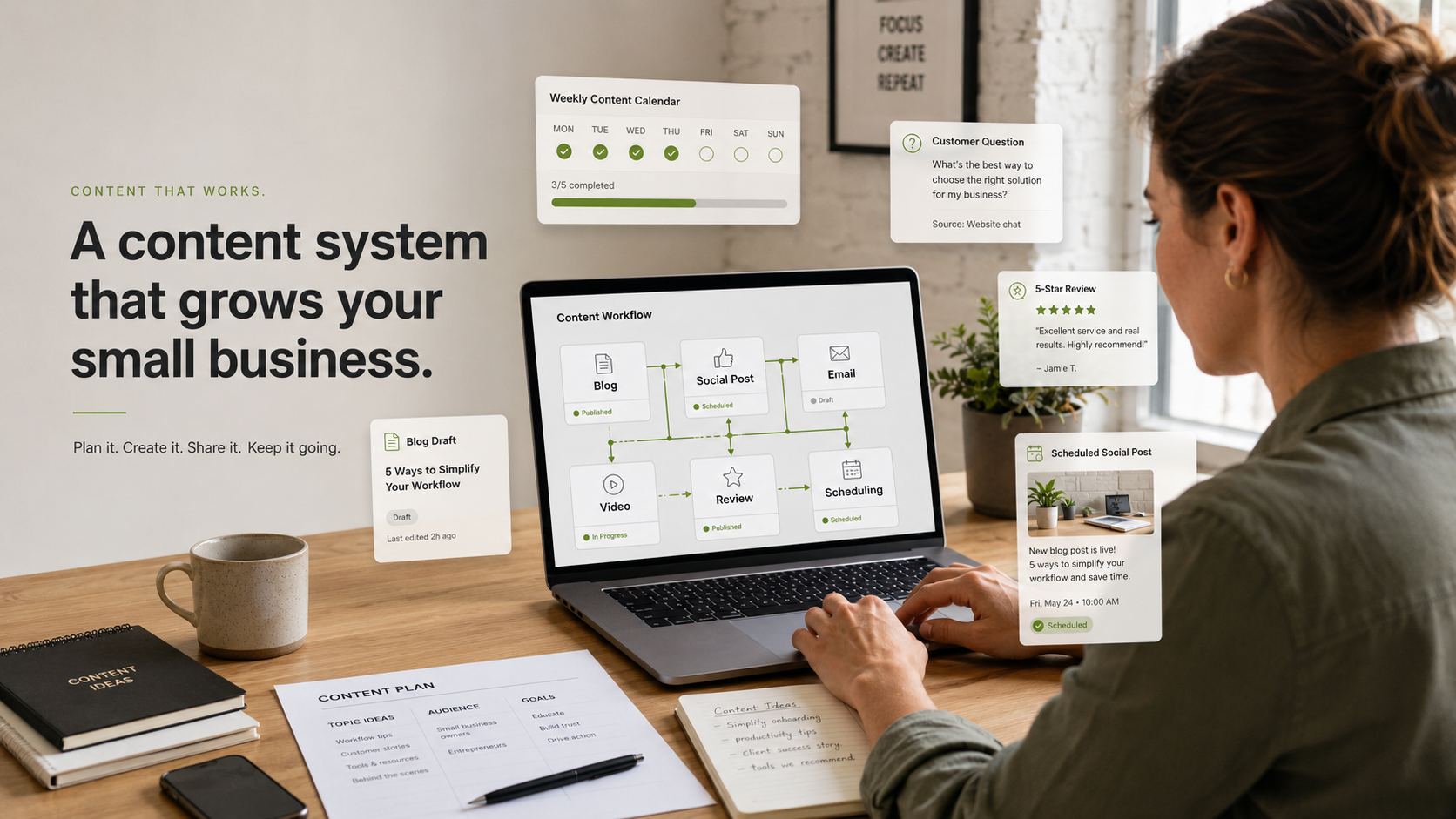
A content marketing system gives your business a repeatable way to create, organize, publish, and reuse content without reinventing your entire brand every week.
It turns content from a random task into a working rhythm.
That matters because consistency builds recognition. Recognition builds trust. Trust makes it easier for people to choose you when they finally need what you offer.
The goal is not to become an influencer.
The goal is to make your business feel alive, useful, and easier to remember.
Content should support your business, not become a second job with worse hours.
This guide breaks down what a content marketing system is, why it matters, how to build one, what tools can help, and when it makes sense to have the system built for you.
Because posting once in a while is activity.
A content marketing system is infrastructure.
Quick Answer: What Is a Content Marketing System?
A content marketing system is a repeatable process for planning, creating, publishing, repurposing, and tracking content.
For small businesses, it helps turn blogs, videos, FAQs, reviews, customer questions, and service topics into consistent marketing assets across your website, email, social media, and follow-up channels.
What a Content Marketing System Really Means
Content marketing is not just posting online.
It is not only blogs.
It is not only social media.
It is not only short videos.
The Content Marketing Institute defines content marketing as a strategic approach focused on creating and distributing valuable, relevant, and consistent content to attract and retain a clearly defined audience.
That word “consistent” is doing a lot of work.
Because consistency is where many businesses fall apart.
A content marketing system helps answer the questions that usually slow everything down.
What are we saying?
Who are we saying it to?
Where does it go?
How often do we publish?
What gets reused?
What supports sales?
What builds trust?
What gets measured?
Without a system, content becomes emotional.
You post when you feel inspired.
You disappear when business gets busy.
You come back when leads slow down.
Then the cycle repeats.
That kind of content rhythm is unstable. It also makes your business look inconsistent from the outside.
A content system gives your marketing a structure that does not depend on mood, memory, or panic.
That is the difference.
Why Small Businesses Struggle With Content Consistency
Small businesses are not short on expertise.
They are usually short on time, structure, and clear decision-making.
The owner knows the business. The team answers customer questions every day. The business has stories, proof, reviews, services, wins, lessons, and examples.
But none of that automatically becomes content.
It has to be captured.
It has to be organized.
It has to be turned into something useful.
That is where most businesses get stuck.
They try to create content directly from their brain to the internet.
That works sometimes.
But it is not sustainable.
A better content marketing system captures ideas before they are needed, organizes them into categories, and turns them into repeatable formats.
For example, one customer question can become a blog section, a short video, a social caption, an email tip, a Google Business Profile update, and a follow-up message.
That is not more work.
That is better use of the same idea.
The business stops asking, “What should we post?”
It starts asking, “Which part of the system are we using today?”
That one shift makes content feel calmer.
Content Should Start With Customer Questions
The easiest way to build a content marketing system is to stop guessing.
Your customers are already telling you what content to create.
They ask questions before they buy.
They ask questions during the process.
They ask questions after the service.
They ask questions when they are confused, nervous, curious, skeptical, or comparing options.
Those questions are content.
If people ask the same thing more than once, it probably deserves a post, a page, a video, or an email.
A service business might answer questions about pricing, timelines, preparation, quality, guarantees, availability, or what happens next.
A local business might answer questions about hours, booking, products, parking, policies, services, location, or how to choose the right option.
A consultant or creator might answer questions about tools, process, results, mistakes, expectations, or common myths.
This is also where Google’s guidance matters. Google’s people-first content guidance encourages content that is created primarily for people, not just search engines.
That is good news for small businesses.
You do not need to sound like a keyword robot wearing a blazer.
You need to be useful.
When your content answers real customer questions clearly, it supports both trust and search visibility.
A Simple Content Marketing System for Small Business
A good content marketing system does not need to be huge.
It needs to be repeatable.
Start with a simple flow.
Capture the idea.
Turn it into one main content piece.
Break that piece into smaller content.
Schedule it.
Track what works.
Improve the system.
That is enough.
The system can be built around one weekly topic. For example, your business could choose one customer question every week and turn it into a short blog, one video, two social posts, and one email tip.
That is not overwhelming.
That is manageable.
And once the rhythm is working, you can increase volume.
The mistake is trying to start with too much.
A business does not need a 90-day content machine on day one if it cannot keep up with one useful post per week.
Start with stability.
Then scale.
The Core Content Pillars Every Business Needs
A content marketing system should not be random.
It should have a few repeatable lanes.
For most small businesses, the main lanes are education, trust, proof, process, and offers.
Education helps people understand problems and solutions.
Trust content helps people feel safe choosing you.
Proof content shows reviews, testimonials, examples, results, or customer experiences.
Process content explains what happens before, during, and after someone works with you.
Offer content tells people how to take the next step.
These lanes keep your content balanced.
If you only post offers, your audience gets tired.
If you only educate, people may not know how to buy.
If you only post behind-the-scenes content, your value may stay unclear.
A good system gives each type of content a job.
Education builds understanding.
Proof builds confidence.
Process reduces hesitation.
Offers create action.
Together, they make your business easier to trust.
Why Repurposing Is the Real Shortcut
Repurposing is where content gets easier.
Not lazy.
Efficient.
A lot of businesses think every platform needs completely original content. That mindset burns people out.
The smarter move is to create one strong idea and adapt it for different places.
A blog can become a YouTube outline.
A YouTube video can become three short clips.
A short clip can become a social caption.
A social caption can become an email.
An email can become a follow-up message.
A review can become a post, a website testimonial, and a sales page proof point.
This is how content becomes a system instead of a treadmill.
If your content needs design support, Envato Elements can help with social templates, video assets, stock visuals, music, and graphics that make repurposing easier.
But the asset library is not the strategy.
The strategy is knowing what each piece of content is supposed to do.
Templates help you move faster.
Systems tell you where to go.
Your Website Should Be Part of the Content System
Social media gets attention, but your website should not be ignored.
Your website is where your strongest content should live.
Blogs, FAQs, service pages, case studies, testimonials, and helpful resources should support your long-term visibility.
Social posts move quickly.
Website content can keep working over time.
That is why content should not only live on Instagram, TikTok, LinkedIn, or Facebook.
Those platforms are useful, but they are rented space.
Your website is owned space.
Google’s SEO Starter Guide is a helpful official resource for understanding how search engines discover and understand website content.
You do not need to become an SEO specialist to use this idea.
You just need to build useful content around the questions people already ask.
A strong content marketing system uses social media for visibility and the website for depth.
One helps people discover you.
The other helps them trust you.
Your CRM Should Connect the System
Content is stronger when it connects to follow-up.
A person may read a blog, download a checklist, watch a video, click a link, fill out a form, or book a consultation.
What happens next?
If nothing happens, the content created interest but the system dropped the moment.
A platform like GoHighLevel can help connect forms, calendars, CRM pipelines, email follow-up, SMS follow-up, review requests, and lead tracking.
That matters because content does not always convert immediately.
Sometimes it warms people up.
Sometimes it answers objections.
Sometimes it creates familiarity over time.
Sometimes it brings people back later.
A CRM helps you capture that journey instead of hoping people remember to come back.
For businesses that want to connect multiple tools or move content between systems, Make can help automate workflows between apps.
For example, a new blog could trigger a task, notify the team, create a social draft, update a content tracker, or start a repurposing workflow.
Again, tools are not the point.
The connected workflow is the point.
How to Measure Whether Your Content Is Working
Content should be creative, but it should not be invisible to measurement.
You need to know what is helping.
That does not mean obsessing over every like, view, or click.
Some metrics are noisy.
But you should have a basic way to understand what content gets attention, what sends traffic, what creates inquiries, and what supports conversion.
Google Analytics can help businesses understand customer journeys and marketing performance. Google also has an Analytics guide for beginners and small businesses that explains the basics of using Analytics.
For a small business, start simple.
Look at which blog posts get visits.
Look at which pages people land on.
Look at which forms get filled out.
Look at which videos create questions.
Look at which topics make people reply.
Look at which posts lead to calls, DMs, or booked appointments.
The goal is not to drown in dashboards.
The goal is to learn what your audience responds to.
Then create more of what works.
The Biggest Mistake: Creating Without a Distribution Plan
A lot of businesses create content and stop too early.
They publish one post and hope the internet notices.
That is not a plan.
That is placing a sandwich in the woods and waiting for applause.
A content marketing system needs distribution.
That means you decide where each piece goes before it is created.
A blog might be shared on LinkedIn, repurposed into Instagram captions, turned into a short video, sent through email, and added to a service page.
A review might become a social graphic, a website testimonial, and a follow-up email.
A customer question might become an FAQ, a blog section, and a sales conversation resource.
Distribution is how one idea gets more life.
It also helps your audience see the message more than once.
That matters because people rarely act the first time they see something.
Consistency creates memory.
Memory creates trust.
Trust creates action.
How to Start Building Your Content System This Week
Start small.
Pick one topic your customers ask about often.
Write a short answer.
Turn that answer into one blog section or short post.
Record a quick video explaining it.
Create one social caption from it.
Save the question in your content tracker.
That is the beginning of a system.
Then do it again next week.
After a few weeks, patterns will appear.
You will notice which questions matter most.
You will notice which posts are easier to create.
You will notice which content leads to conversations.
That is how the system improves.
Not by trying to become perfect immediately.
By creating a repeatable rhythm and refining it.
Build a Content System That Keeps Your Brand Alive
A content marketing system helps your business stay visible without starting from scratch every week.
It turns ideas into assets.
It turns questions into content.
It turns reviews into proof.
It turns posts into conversations.
It turns scattered effort into a rhythm your business can actually maintain.
The DIY route is possible.
You can use your customer questions, Google’s content guidance, Google Analytics, Envato Elements, GoHighLevel, and Make to build a content workflow that supports your business over time.
But if you do not want to build all of that yourself, CLIK Creatives can create a done-for-you content system around your business.
That can include content planning, blog topics, social post structure, repurposing workflows, review content, automation setup, CRM integration, and a publishing rhythm that fits how your business actually works.
You do not need more random posts.
You need a system that keeps your brand visible, useful, and easier to trust.
If your content feels scattered, inconsistent, or exhausting, CLIK Creatives can help turn it into a calm, repeatable growth system.
Quick note: Some links in this article may be affiliate links, which means CLIK Creatives may earn a commission if you buy through them, at no extra cost to you. This keeps things clear for readers and aligned with FTC endorsement guidance.
FAQ
What is a content marketing system?
A content marketing system is a repeatable process for planning, creating, publishing, repurposing, and measuring content across your website, social media, email, and follow-up channels.
Why does a small business need a content marketing system?
Small businesses need a content marketing system because consistency is hard when every post starts from zero. A system makes content easier to create and easier to repeat.
What should small businesses post about?
Small businesses should post about customer questions, common problems, service explanations, reviews, behind-the-scenes moments, process details, and helpful tips that build trust.
How often should a small business publish content?
Start with a rhythm you can actually maintain. One strong topic per week can become a blog, a video, a few social posts, and an email.
Is blogging still useful for small businesses?
Yes. Blogging gives your business owned content that can support search visibility, answer customer questions, and provide deeper trust than short social posts.
What is content repurposing?
Content repurposing means turning one idea into multiple formats. For example, a blog can become a video, social caption, email, FAQ, or sales resource.
What tools help with content systems?
Useful tools can include a website, CRM, content calendar, design asset library, automation platform, analytics tool, and scheduling workflow.
Should AI be used for content marketing?
AI can help with drafts, outlines, repurposing, and workflow speed, but the content still needs human judgment, real examples, and clear brand direction.
How do I know if my content is working?
Look at website traffic, form submissions, calls, DMs, email replies, booked appointments, and which topics create conversations with real customers.
Can CLIK Creatives build a content marketing system?
Yes. CLIK Creatives can build a done-for-you content system that connects blogs, social media, reviews, CRM follow-up, and automation into a repeatable workflow.
2026 Refresh: Content Marketing Needs a Workflow, Not Just Ideas
A content marketing system should help the business stay visible without starting from scratch every week. That requires a repeatable workflow: choose the customer problem, map it to the right service pathway, research the claim, draft the asset, repurpose it, link it, and measure what happened.
Google?s own SEO guidance emphasizes helping search engines understand content while helping people decide whether to visit. That is a useful standard for small businesses: content should be clear enough for search and specific enough for the buyer.
The content system checklist
- Topic bank tied to real services, audience stages, and customer questions.
- One primary promise per article or asset.
- Internal links to related service and education pages.
- External sources for changing claims.
- Repurposing plan for social, email, and sales follow-up.
- CTA matched to the buyer?s readiness.
CLIK system tie-in: content should support The Core, The Signal, or The Lab, then connect back to Website Systems, Reputation Systems, Business Systems, or Special Services.
Related reading: Modern Marketing Strategy for Small Business and Online Presence for Small Business.