
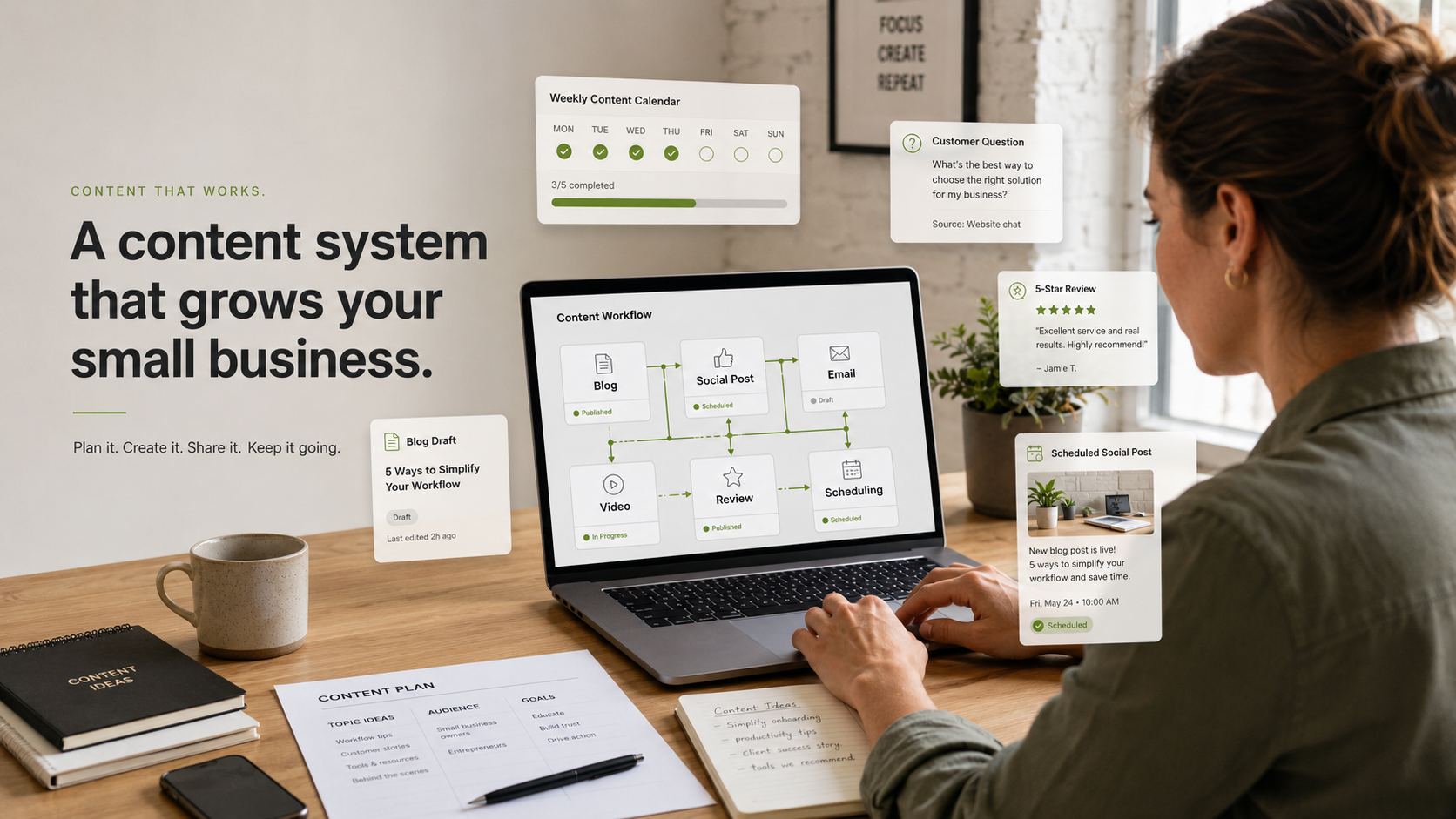
Content Marketing System: How to Stay Visible Without Starting From Scratch Every Week
Introduction: Posting Is Not the Problem A content marketing system is what most small businesses are missing. Not more motivation. Not another random content idea. Not a new app that promises to make everything easy while quietly adding one more login to your life. Most businesses do not struggle with content because they have nothing to say. They struggle because every post starts from zero. That is the real problem. The owner sits down and asks, “What should I post today?” Then the brain immediately opens 47 tabs. Should it be educational? Should it be funny? Should it be a reel? Should it be a carousel? Should it be about the service? Should it be about the team? Should it be a trend? Should it be serious? Should it be posted now or later? And by the time all those questions finish fighting in the parking lot, nothing gets posted. That is not a creativity problem. That is a system problem. A content marketing system gives your business a repeatable way to create, organize, publish, and reuse content without reinventing your entire brand every week. It turns content from a random task into a working rhythm. That matters because consistency builds recognition. Recognition builds trust. Trust makes it easier for people to choose you when they finally need what you offer. The goal is not to become an influencer. The goal is to make your business feel alive, useful, and easier to remember. Content should support your business, not become a second job with worse hours. This guide breaks down what a content marketing system is, why it matters, how to build one, what tools can help, and when it makes sense to have the system built for you. Because posting once in a while is activity. A content marketing system is infrastructure. Quick Answer: What Is a Content Marketing System? A content marketing system is a repeatable process for planning, creating, publishing, repurposing, and tracking content. For small businesses, it helps turn blogs, videos, FAQs, reviews, customer questions, and service topics into consistent marketing assets across your website, email, social media, and follow-up channels. What a Content Marketing System Really Means Content marketing is not just posting online. It is not only blogs. It is not only social media. It is not only short videos. The Content Marketing Institute defines content marketing as a strategic approach focused on creating and distributing valuable, relevant, and consistent content to attract and retain a clearly defined audience. That word “consistent” is doing a lot of work. Because consistency is where many businesses fall apart. A content marketing system helps answer the questions that usually slow everything down. What are we saying? Who are we saying it to? Where does it go? How often do we publish? What gets reused? What supports sales? What builds trust? What gets measured? Without a system, content becomes emotional. You post when you feel inspired. You disappear when business gets busy. You come back when leads slow down. Then the cycle repeats. That kind of content rhythm is unstable. It also makes your business look inconsistent from the outside. A content system gives your marketing a structure that does not depend on mood, memory, or panic. That is the difference. Why Small Businesses Struggle With Content Consistency Small businesses are not short on expertise. They are usually short on time, structure, and clear decision-making. The owner knows the business. The team answers customer questions every day. The business has stories, proof, reviews, services, wins, lessons, and examples. But none of that automatically becomes content. It has to be captured. It has to be organized. It has to be turned into something useful. That is where most businesses get stuck. They try to create content directly from their brain to the internet. That works sometimes. But it is not sustainable. A better content marketing system captures ideas before they are needed, organizes them into categories, and turns them into repeatable formats. For example, one customer question can become a blog section, a short video, a social caption, an email tip, a Google Business Profile update, and a follow-up message. That is not more work. That is better use of the same idea. The business stops asking, “What should we post?” It starts asking, “Which part of the system are we using today?” That one shift makes content feel calmer. Content Should Start With Customer Questions The easiest way to build a content marketing system is to stop guessing. Your customers are already telling you what content to create. They ask questions before they buy. They ask questions during the process. They ask questions after the service. They ask questions when they are confused, nervous, curious, skeptical, or comparing options. Those questions are content. If people ask the same thing more than once, it probably deserves a post, a page, a video, or an email. A service business might answer questions about pricing, timelines, preparation, quality, guarantees, availability, or what happens next. A local business might answer questions about hours, booking, products, parking, policies, services, location, or how to choose the right option. A consultant or creator might answer questions about tools, process, results, mistakes, expectations, or common myths. This is also where Google’s guidance matters. Google’s people-first content guidance encourages content that is created primarily for people, not just search engines. That is good news for small businesses. You do not need to sound like a keyword robot wearing a blazer. You need to be useful. When your content answers real customer questions clearly, it supports both trust and search visibility. A Simple Content Marketing System for Small Business A good content marketing system does not need to be huge. It needs to be repeatable. Start with a simple flow. Capture the idea. Turn it into one main content piece. Break that piece into smaller content. Schedule it. Track what works. Improve the system. That is enough. The system can be built around one weekly topic. For